
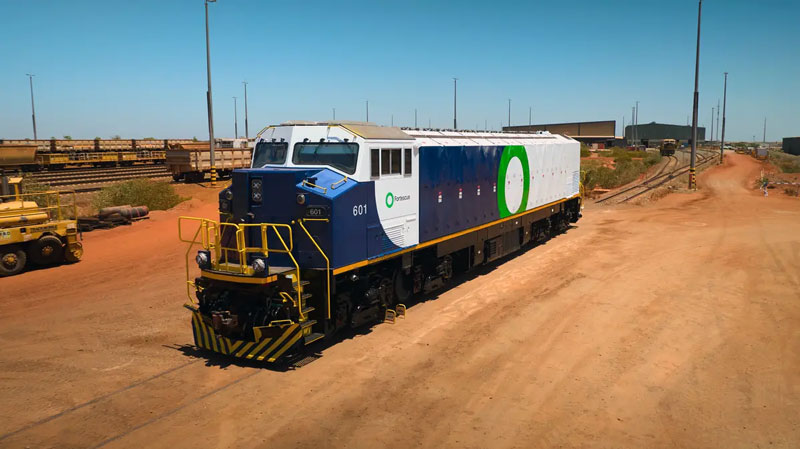
In a move the company has called a Real Zero milestone, Fortescue confirmed it has commenced commissioning of two new battery-electric locomotives on its rail network for its Pilbara iron ore operations.
The pair of locos were delivered by Progress Rail, and they will together eliminate around 1 million litres of diesel each year. At their hearts: the world’s largest land-mobile batteries, with a capacity of 14.5 MWh each – and which can each recover 40-60% of energy through regenerative braking.
They will operate on renewable power delivered via Fortescue’s Pilbara Energy Connect program.
Fortescue Metals and Operations CEO Dino Otranto said that Real Zero is about transforming the way assets are powered, moving materials and running operations, not offsetting emissions – but eliminating them.
“Decarbonising our rail network is a critical part of that task and the commissioning of these battery electric locomotives demonstrates that heavy-haul rail can operate reliably without fossil fuels,” he said.
“For a mining operation of this scale, decarbonisation only works if renewable energy is firm, reliable and available 24/7. That’s why we’re building an integrated system combining large-scale solar and wind generation, battery storage and transmission infrastructure.”
Alongside Pilbara Energy Connect, Fortescue has constructed more than 480 kilometres of high-voltage transmission lines, all physically linking the miner’s energy assets to its operations and rail network.
“This infrastructure enables renewable power to replace diesel and gas, in real time, across the Pilbara,” he added.
At North Star Junction, Fortescue already operates a 100 MW solar farm, which will be supported by a recently installed 250MWh battery energy storage system (BESS) capable of delivering up to 50 MW of power for five hours. The system plays a critical role in stabilising renewable supply for Fortescue’s operations.
Building on Fortescue’s solar generation portfolio, construction is progressing at the 190-MW Cloudbreak Solar Farm, which is around two-thirds complete. Fortescue has also received all primary approvals for the up to 644-MW Turner River Solar Farm, with construction anticipated to commence later this year, while a 440-MW solar farm at Solomon remains in the near-term pipeline. Together, these projects will expand Fortescue’s renewable energy footprint in the Pilbara and support the delivery of its Real Zero Target.
Other Pilbara decarbonisation milestones include:
- Commencement of construction of Fortescue’s first Pilbara wind project, the Nullagine Wind Project
- Expansion of electric mining equipment, with one electric drill and 12 electric excavators now operational across multiple sites
- Strategic global partnerships across solar, wind, energy storage and electrified heavy equipment, supporting large-scale deployment
- Investment in next-generation renewable technology, including acquisition of Nabrawind to support future Pilbara wind projects
Fortescue said its Climate Transition Plan sets out the pathway to deliver the company’s Real Zero Target, eliminating Scope 1 and 2 emissions from its Australian terrestrial iron ore operations by the end of 2030.